

The 15-second answer
Do we serve Bryant?
Service Restoration serves Bryant from its two Little Rock offices, about 20 miles southwest on I-30. The 24/7 call center qualifies the job and dispatches a local team, typically on-site within 60 minutes, depending on drive time, traffic, road conditions and call volume. Every job starts with a free inspection, not a quote over the phone.
Key takeaways
- Bryant is served from two Little Rock offices, each rated 5.0 stars on Google, about 20 miles up I-30.
- A local crew is typically on-site within 60 minutes, depending on drive time, traffic, road conditions and call volume.
- Upstairs laundry leaks, attic HVAC and water heater overflows, slab leaks under continuous flooring and burst attic lines after a freeze shape most Bryant calls.
- Retail, hotels, schools and churches along I-30 get multiple crews and the company's own temporary power and air conditioning.
- Every job starts with a free inspection, and insurance coverage is decided by the policy and adjuster case by case, never promised.
Last updated
Bryant is the closest Saline County city to Service Restoration's Little Rock base, and for most Bryant homes the drive is shorter than the run from one side of Little Rock to the other. The company's two offices, at 9524 I-30 and 7821 Doyle Springs Rd Suite F, are each rated 5.0 stars on Google, from 103 reviews and 32 reviews, and the I-30 office sits on the same interstate that runs through the middle of Bryant. There is no office in Bryant itself. A call goes to the 24/7 call center, which qualifies the job and sends a local team, typically on-site within 60 minutes, depending on drive time, traffic, road conditions and call volume. The weak spot in that drive is I-30 itself at rush hour, when the commute between Saline County and Little Rock backs up in both directions, and the call center will tell you if that is going to add time. Service Restoration was founded in 2014 and is independently owned, not a franchise.
Most of Bryant was built recently. The city has grown from a small town into one of the larger cities in central Arkansas over the last few decades, and the bulk of its housing is subdivisions from the 1990s onward, spread out along Reynolds Road, Alcoa Road and the roads that branch off them. Alcoa Road is a reminder of the bauxite mining that shaped this part of Saline County long before the subdivisions arrived. The typical Bryant house is brick or siding on a concrete slab, often two stories, with the laundry room upstairs or off the kitchen, a water heater in the garage or the attic, and an ice maker line running behind the refrigerator. That layout sets the pattern for water damage here. Basements are rare, so the calls are about a washing machine hose that splits on the second floor and comes through the ceiling of the living room below, a water heater that lets go in the attic, or a supply line under a sink that has been dripping into the cabinet base for weeks.
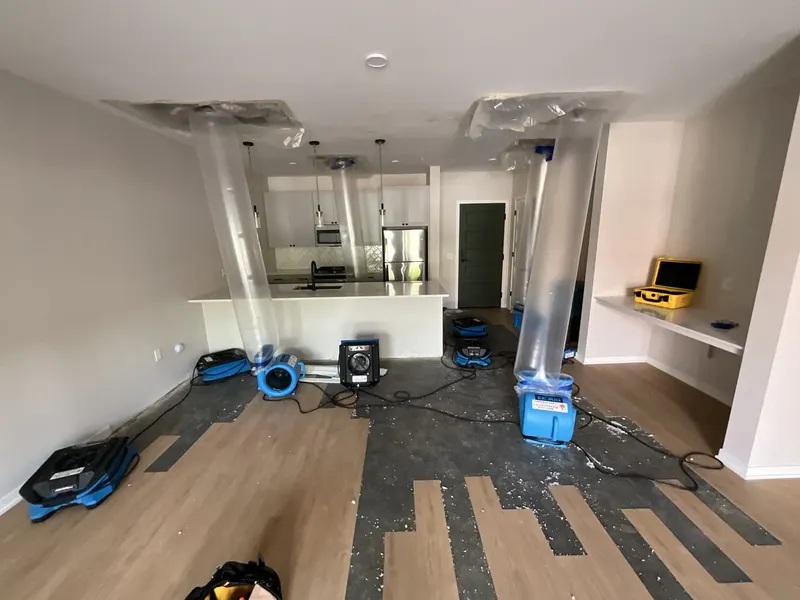
On a slab, water spreads sideways. A leak in a Bryant kitchen runs under the cabinets, under laminate or luxury vinyl plank and carpet pad, and wicks up the bottom of the drywall in the next room, often reaching two or three rooms before anyone sees it. Many newer homes have continuous flooring through the whole downstairs, which is good to live with and harder to save after a leak, because the flooring can only be dried or replaced as one piece. The technician traces the water with moisture meters and thermal imaging before anything is removed, and dries flooring, cabinets and drywall in place where the readings say it is possible. When the readings say it is not, the technician explains why before any demolition starts. A second common Bryant problem comes from the attic. Many of these homes have the air handler upstairs or in the attic, and in a humid Arkansas summer a clogged condensate line or a rusted drain pan overflows into the ceiling below. It looks small at first, a brown ring on the ceiling, and it is usually larger by the time the drywall sags.
Winter brings the other big Bryant call. Two-story homes built on open lots often have supply lines running through the attic or in exterior walls, and a hard freeze is when those lines burst. During the Arctic outbreaks of February 2021 and December 2022, freezes like that hit every part of central Arkansas within the same few days, and in a city full of homes built to the same plans, a lot of neighbors had the same failure on the same morning. The first steps are the same every time. Shut the water off at the main, switch off power to the wet rooms if you can reach the panel safely, and do not put a torch or heat gun on a frozen line. A burst attic line drops most of its water into the insulation and ceiling drywall where you cannot see it, which is what the thermal camera is for on the first visit.
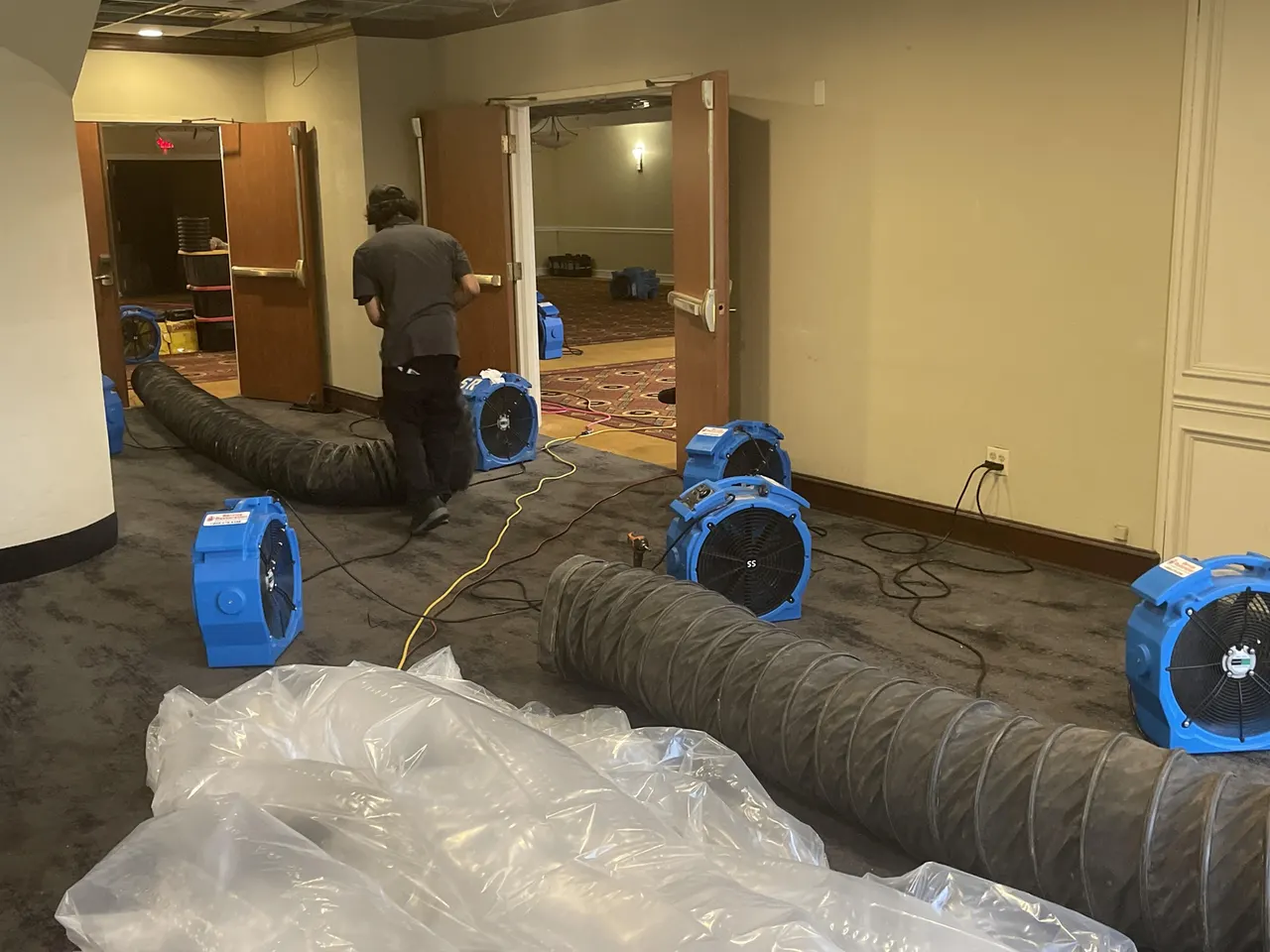
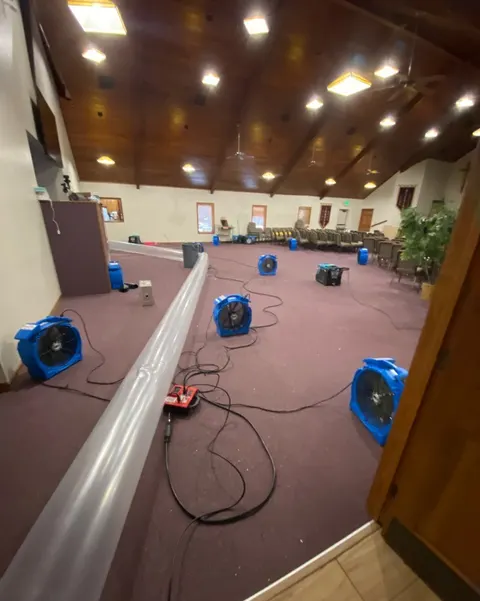
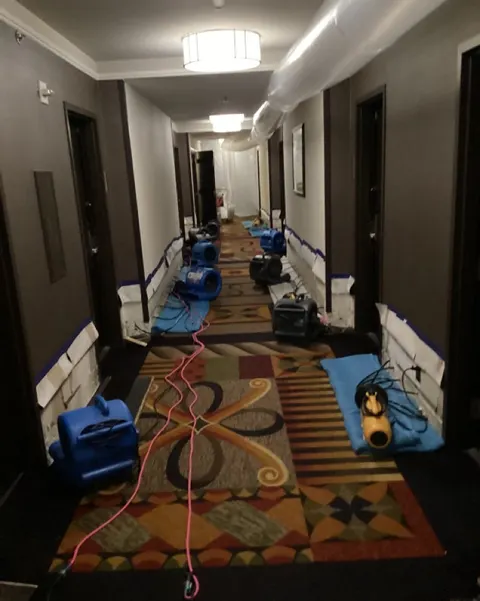
Bryant's commercial side runs along I-30, where the retail centers, restaurants, hotels and offices are, and out through the schools, large churches and medical offices across the city. Those buildings run sprinkler systems, rooftop units and long plumbing runs that can fail at night or over a weekend and reach several tenants before anyone notices. The company's commercial experience covers hotels, churches and office buildings, and it keeps case studies from larger jobs, including a college building in Little Rock. On a big loss the team sends multiple crews and brings its own temporary power and air conditioning from its equipment library, so drying starts the same day instead of waiting on a rental company. Flash flooding is the other Bryant risk worth knowing about. A spring storm that drops several inches in a few hours can overload ditches and storm drains in a city where so much ground has been paved, and water that comes into a garage or across a slab from outside is handled as contaminated water.
Fire and smoke damage in Bryant is handled by one company from start to finish: soot and smoke cleanup, extracting the water the Bryant Fire Department left behind, cleaning and storing contents, and the reconstruction that follows. Storm calls get the same treatment, with emergency tarping and debris removal first and drying right behind it. Every job starts with a free inspection, and the loss is written up in Xactimate, the estimating software insurance adjusters use. Coverage is decided by the policy and the adjuster, case by case, and nobody on the team promises it. What the team does is document the loss for your adjuster before the first piece of drywall comes out.
What causes the most water, fire and storm damage in Bryant?
Bryant has the same humid subtropical climate as the rest of central Arkansas, and spring is the hard season for property damage. From March into May, severe thunderstorms cross Saline County with large hail, straight-line winds and tornado warnings. Hail is a particular problem in a city of newer roofs and siding, and a damaged roof lets rain into the attic long before it shows on a ceiling. The same storms can drop inches of rain in an hour and overload drainage ditches and storm drains around subdivisions. Winter is mild most years, which is why it catches people out when it isn't. An ice storm or a run of nights in the teens, like February 2021 and December 2022, bursts supply lines in attics and exterior walls across the city in the same few days. Summers bring 90 degree days with heavy humidity, so attic air handlers run hard and condensate lines clog and overflow, wet material dries slowly, and a leak that is not dried within a day or two can spread and lead to mold.
What do Bryant jobs usually involve?
- Upstairs laundry, washing machine hose and supply line leaks in two-story Bryant homes, where water comes through the ceiling of the room below
- Slab leaks and kitchen or bathroom water losses under continuous laminate and vinyl plank flooring, traced with meters and thermal imaging and dried in place where the readings allow
- Attic water heater failures and overflowing HVAC condensate lines and drain pans that soak insulation and ceiling drywall
- Burst attic and exterior wall supply lines after an ice storm or hard freeze
- Sprinkler and plumbing losses in retail centers, hotels, schools, churches and medical offices along I-30, with multiple crews and the company's own temporary power and air conditioning
- Emergency tarping after hail and wind, then fire and smoke cleanup, contents cleaning and storage, and reconstruction by the same company
Which Bryant neighborhoods do we cover?
Near Bishop Park, Bryant High School, I-30.
Which restoration services do we offer in Bryant?
Bryant questions
Bryant is about 20 miles down I-30 from the Little Rock offices, so a crew is typically on-site within 60 minutes once the call center has qualified the job. That window depends on drive time, traffic, road conditions and call volume, and rush hour on I-30 or ice on the interstate will stretch it. The call center answers 24 hours a day, every day of the year, and tells you plainly when to expect the team.
Turn off the water supply valves behind the washer, or shut off the main if you cannot reach them. In most Bryant homes the main is at the meter box near the street, and in some newer homes there is also a shutoff in the garage. If water is near light fixtures or ceiling fans, switch those circuits off at the breaker panel, and do not stand under a sagging ceiling. Put a bucket under the drip, move furniture and electronics out of the way, and call. Most of the water from an upstairs leak ends up in the ceiling cavity and the wall below, which the technician finds with a thermal camera and meters on the first visit.
It can be. A ceiling stain under an attic HVAC unit usually means the condensate line has clogged or the drain pan has rusted through, and the unit has been dripping into the insulation and drywall for some time. The technician checks the attic and the ceiling with meters and thermal imaging to see how far the water has spread, removes wet insulation and drywall only where the readings call for it, and dries the framing. Your HVAC company will need to clear the line or replace the pan so it does not happen again.
For drying and mitigation only, an average flooded basement runs about $5,000 to $10,000 and an average kitchen water loss about $3,000 to $5,000. A rebuild that includes continuous flooring across several rooms, as when a slab leak spreads under the whole living area of a ranch, can take a job to $40,000 to $50,000. Those are ranges from completed jobs, not a quote for your house. The number for your property is confirmed by the free inspection, because nobody can price a water loss honestly before a technician has metered it.
That is decided by your policy and your adjuster, case by case, and nobody on the team will promise it. A sudden burst pipe or a failed water heater is usually treated differently from a slow leak that has run for weeks, and water that came in from outside during a storm is a flood policy question that a standard homeowner policy does not answer. What the team does is document the loss in Xactimate during the free inspection, with photos and moisture readings, and work with your adjuster once the claim is open so everyone is looking at the same scope.
Yes. The first job is to stop more water getting in, so the crew tarps the damaged area and clears any debris, then starts drying the attic and the rooms underneath. Wet insulation and ceiling drywall are removed, the framing is metered and dried, and contents are cleaned and stored while the work goes on. If the house needs rebuilding afterward, the same company handles the reconstruction, so there is no second contractor to find after a hail storm when every roofer in Saline County is booked.
All of Bryant, from the I-30 corridor out along Reynolds Road and Alcoa Road, plus Shannon Hills, Alexander, Benton and the rest of Saline County. Bryant sits well inside the roughly 90 minute radius the two Little Rock offices cover. The farther out you are from I-30, the longer the drive, and the call center will give you a straight answer on timing.