

The 15-second answer
What does storm damage restoration involve?
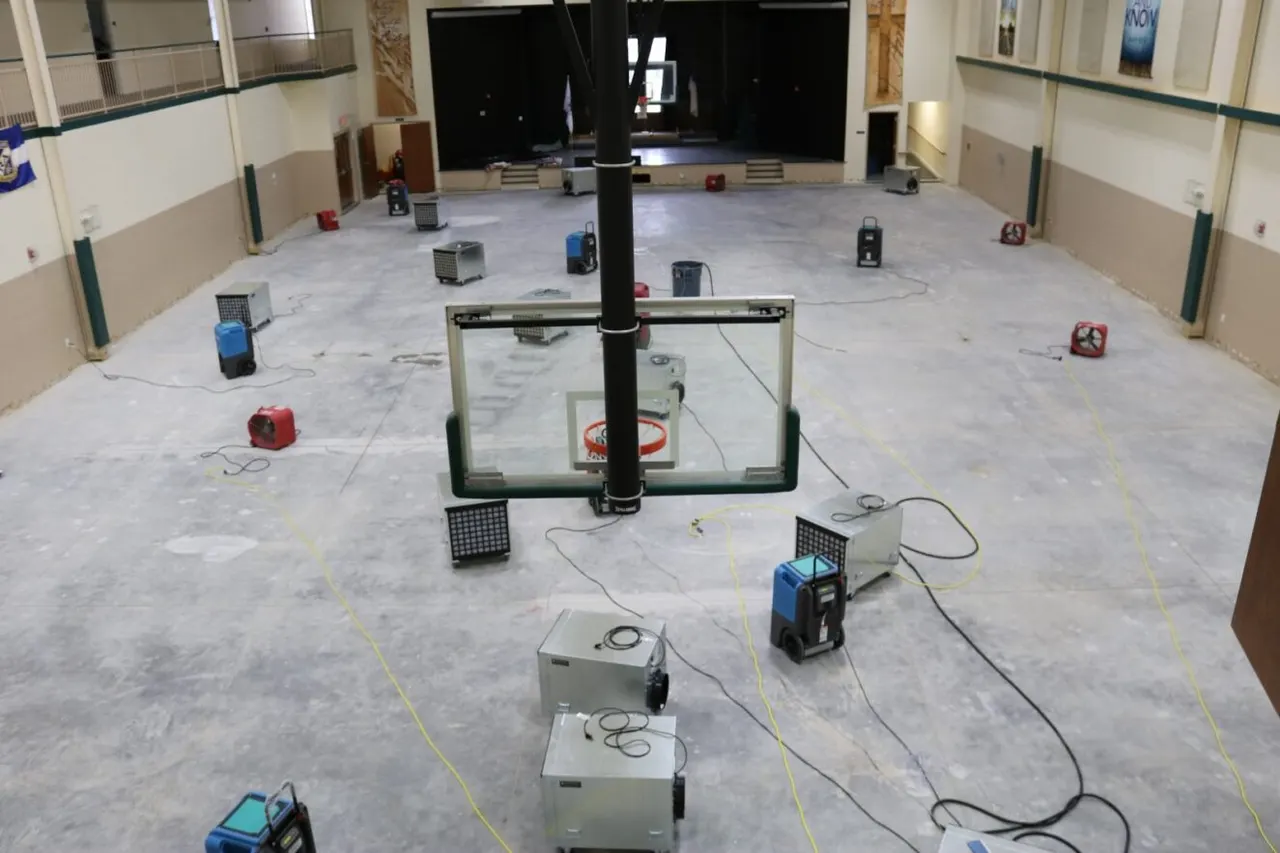
Storm damage restoration starts with stopping the water: emergency tarping, board-up and debris removal, then extraction and drying inside. Service Restoration of Arkansas handles hail, wind, tornado and ice storm damage across central Arkansas, with a local crew typically on-site within 60 minutes, depending on drive time, traffic, road conditions and call volume.
Key takeaways
- The first visit after a storm is about stopping the water: tarping, board-up and debris removal, typically within 60 minutes depending on drive time, traffic, road conditions and call volume.
- Storm calls around Little Rock run from spring hail, straight-line wind and tornadoes to flash flooding and winter ice storms.
- Central Arkansas crews respond to spring severe storms and tornado damage across roughly a 90 minute radius from Little Rock.
- Interior water from a storm is extracted and dried as part of the same job.
- Damage is photographed before it is covered, and the scope is written in Xactimate for the insurer. Coverage itself depends on the policy.
Last updated
Storm damage is almost always a water problem wearing a different coat. Hail splits shingles, wind peels back a section of roof or drops a tree limb through it, a window blows in, and from that moment every hour of rain adds more wet drywall, insulation and flooring under the opening. The storm itself is over in minutes. The damage keeps growing until the building is sealed. That is why Service Restoration treats the first visit after a storm as an emergency stop-the-water call, not a scheduled repair appointment.
The first job is to close the building up. Roof openings get tarped and battened down so the next rain stays out, broken windows and doors get boarded, and the debris that came down, from branches to collapsed sections of ceiling, is cleared so the crew can get at the damage underneath. Then the work shifts to what a water loss always needs: extraction, drying equipment, and moisture readings until the structure is dry. Once it is, the same company rebuilds the roof section, the ceiling and whatever else came out, so the customer is not lining up a tarping crew, a drying company and a contractor separately.
In central Arkansas the hard season runs from March into May. Severe thunderstorms roll across the state with large hail, straight-line wind and tornadoes, and the EF3 tornado of March 31, 2023 that cut through West Little Rock and across the river into North Little Rock and Sherwood is the recent reminder of what that season can do. The same storms can drop inches of rain in an hour, putting creeks out of their banks and backing up storm drains, and water that comes in from outside is handled as contaminated water. Winter is mild most years, but an ice storm brings limbs down through roofs as surely as a spring storm does. Each of these is a different repair, but the response is the same: get the water stopped, then dry.
After a big weather event, calls come in all at once, and a crew that already lives and works in the area can reach properties faster than one being routed in from out of state. Service Restoration's two Little Rock offices respond across roughly a 90 minute radius, from North Little Rock and Sherwood to Conway, Benton and Hot Springs, with tarping, board-up and drying equipment from the company's own library.
Before Service Restoration became a restoration company in 2014, the business did insurance-based roofing work, and founder Dan spent close to 30 years as a licensed contractor, so a storm-damaged roof is familiar ground. One of the company's own before and after photo sets shows a church roof with its decking exposed and debris tarped after a storm, and the same roof fully reshingled when the job was done. That is the full arc of a storm job: secure it, dry it, rebuild it.
Insurance is part of most storm jobs, and Service Restoration does not promise what a policy will pay, because that is decided by the policy and the adjuster. What the team does is photograph the damage before the tarp goes on, keep a record of every emergency step, and write the scope in Xactimate, the estimating software most insurers use, so the adjuster and the crew are working from the same document. When a storm has also taken the power out, the crew can bring temporary power and air conditioning from the company's own equipment library rather than waiting on a rental company, which keeps drying equipment running when it matters most.
What is included?
- Emergency roof tarping
- Heavy-duty tarps are fitted over roof openings and secured with battens so they hold through the next storm, not just the next breeze. Where decking is gone, the opening is covered rather than draped. Tarping is a temporary measure to stop water, and the free inspection sets out what the permanent roof repair will involve.
- Board-up and debris removal
- Broken windows, doors and wall openings are boarded, and downed branches, broken glass, loose shingles and collapsed ceiling material are removed from inside and around the building. Trees that have come through a roof are cut back and cleared so the opening can be covered. Debris is hauled away rather than piled in the yard.
- Water extraction and drying after a storm
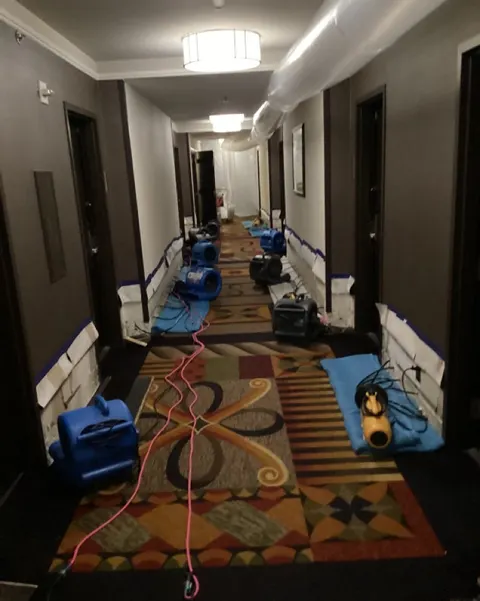
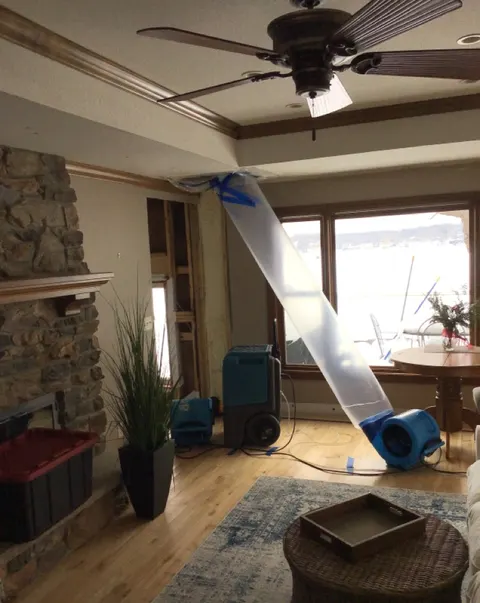
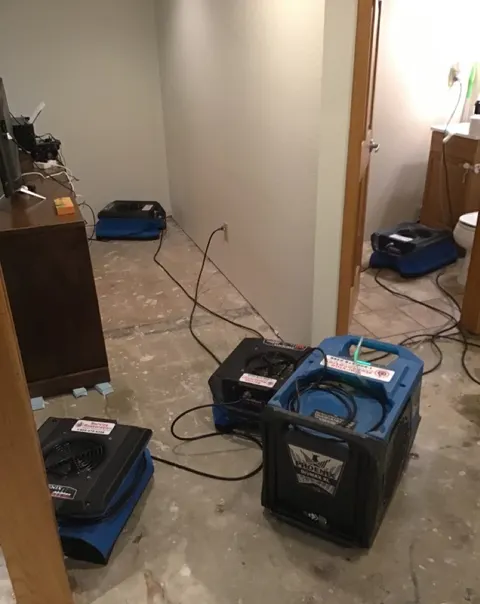
- Rain that came through the roof or a broken window is extracted, and air movers and dehumidifiers are placed to dry ceilings, walls, insulation and flooring. Moisture is tracked with meters and thermal imaging so wet material inside a wall cavity is found and dried, not painted over.
- Hail, wind and tornado damage
- Hail bruises shingles and cracks skylights and siding. Wind lifts shingles and drives rain under them. A tornado or a falling tree can open a roof or a wall entirely. Each is inspected for what it did inside the building as well as outside, because the interior water damage is often larger than the roof damage that caused it.
- Storm damage repair and rebuild
- Once the structure is dry, the same company repairs the roof section, replaces ceiling and wall drywall, insulation, trim and flooring, and repaints, so the storm job finishes as a finished room rather than a dried-out shell waiting for another contractor.
How does the job run?
Call for a free inspection, day or night
The call center takes what the storm did, whether water is still coming in, and whether the building is safe to be in. After a large storm, the call center qualifies every job before dispatch so crews are not sent where they cannot help yet, and a local crew is sent to the properties where they can.
Secure the building
Typically within 60 minutes, depending on drive time, traffic, road conditions and call volume, a crew tarps roof openings, boards broken windows and doors, and clears debris blocking access. Everything is photographed before it is covered so the record of the damage is complete.
Inspect inside and out
A technician checks the roof, siding and windows, then traces where the water went inside with moisture meters and thermal imaging. You get a straight read on what is wet, what can be dried and what has to come out.
Dry the structure
Extraction and drying equipment goes in the same visit. Moisture readings are taken over the following days until the structure reads dry, and the scope for repairs is written in Xactimate from what was found.
Repair and rebuild
Roofing, drywall, insulation, flooring and paint are restored by the same company. Contents that were soaked or covered in debris can be cleaned and stored while the work runs.
What does it cost?
Storm jobs vary too much for a single typical range, and Service Restoration does not quote them over the phone. The emergency stage, tarping, board-up and debris removal, depends on how much of the roof is open and how much came down. The drying stage depends on how long rain was getting in before the building was sealed and how far it spread. The repair stage depends on whether the damage is a few shingles and a ceiling patch or a section of roof, insulation and several rooms of drywall. A storm that is caught and tarped the same day is a far smaller job than one that leaks through a week of rain. The free inspection sets the scope, the scope is written in Xactimate, and the price follows from what was actually found. Most storm work is insurance related, and the documentation is built for that, though coverage itself is decided by the policy.
Areas we cover
- Little RockPulaski County, AR
- BentonSaline County, AR
- BryantSaline County, AR
- CabotLonoke County, AR
- ConwayFaulkner County, AR
- Hot SpringsGarland County, AR
- JacksonvillePulaski County, AR
- MaumellePulaski County, AR
- North Little RockPulaski County, AR
- Pine BluffJefferson County, AR
- SearcyWhite County, AR
- SherwoodPulaski County, AR
Storm Damage Restoration questions
A local crew is typically on-site within 60 minutes, depending on drive time, traffic, road conditions and how many calls are active. After a widespread storm that last factor matters, because dozens of properties can be hit in the same hour, which is why the call center qualifies each job before a crew is dispatched. Service Restoration of Arkansas runs local crews out of two Little Rock offices, so the response does not depend on a truck driving in from another state.
Stay out of any area with a sagging ceiling, downed power lines or standing water near electrical outlets. If it is safe, move belongings out from under the leak and put a bucket under active drips. Take photos of everything before anything is moved or covered. Then call for a free inspection rather than climbing onto the roof yourself. A wet, damaged roof is dangerous footing, and the crew brings the equipment to tarp it safely.
Many homeowner policies cover sudden storm damage from wind and hail, but what a given policy pays depends on its wording, its deductible and what the adjuster finds, so Service Restoration does not promise coverage. Most policies also expect the owner to take reasonable steps to stop further damage, which is what emergency tarping and board-up are. The crew photographs the damage before covering it, keeps records of every emergency step, and writes the repair scope in Xactimate for the adjuster.
Yes. An ice storm brings down limbs and power lines, and a limb through the roof lets water in as the ice melts. A hard freeze in the same week can also burst attic and exterior wall supply lines in houses that were never built for sub-freezing weather. The crew tarps any opening, traces the water inside with meters and thermal imaging, and dries it the same way as any other leak, and the roof section is repaired once it is safe to work on.
Yes. Hail splits and bruises asphalt shingles, cracks skylights and dents or punctures siding, and wind drives rain through those openings. The inspection covers the roof and exterior and then traces any water that got inside. The interior drying and the exterior repair are handled by the same company, which matters because the ceiling damage under a hail-hit roof is often larger than the roof damage itself.
Yes. Spring severe weather around Little Rock brings tornado warnings, straight-line wind and heavy rain, and the two Little Rock offices cover roughly a 90 minute radius for emergency tarping, board-up, debris removal and drying. On a tornado-damaged property the first visit is about making the building safe and weather tight, with the full inspection and repair scope following once the structure can be entered safely.
Yes. Service Restoration keeps its own equipment library, including temporary power and air conditioning, so drying equipment can run on a property that has lost power rather than waiting for the utility to restore it or for a rental company to deliver a generator. On a commercial building, that can be the difference between drying the structure on schedule and losing a week to a dark, humid interior.